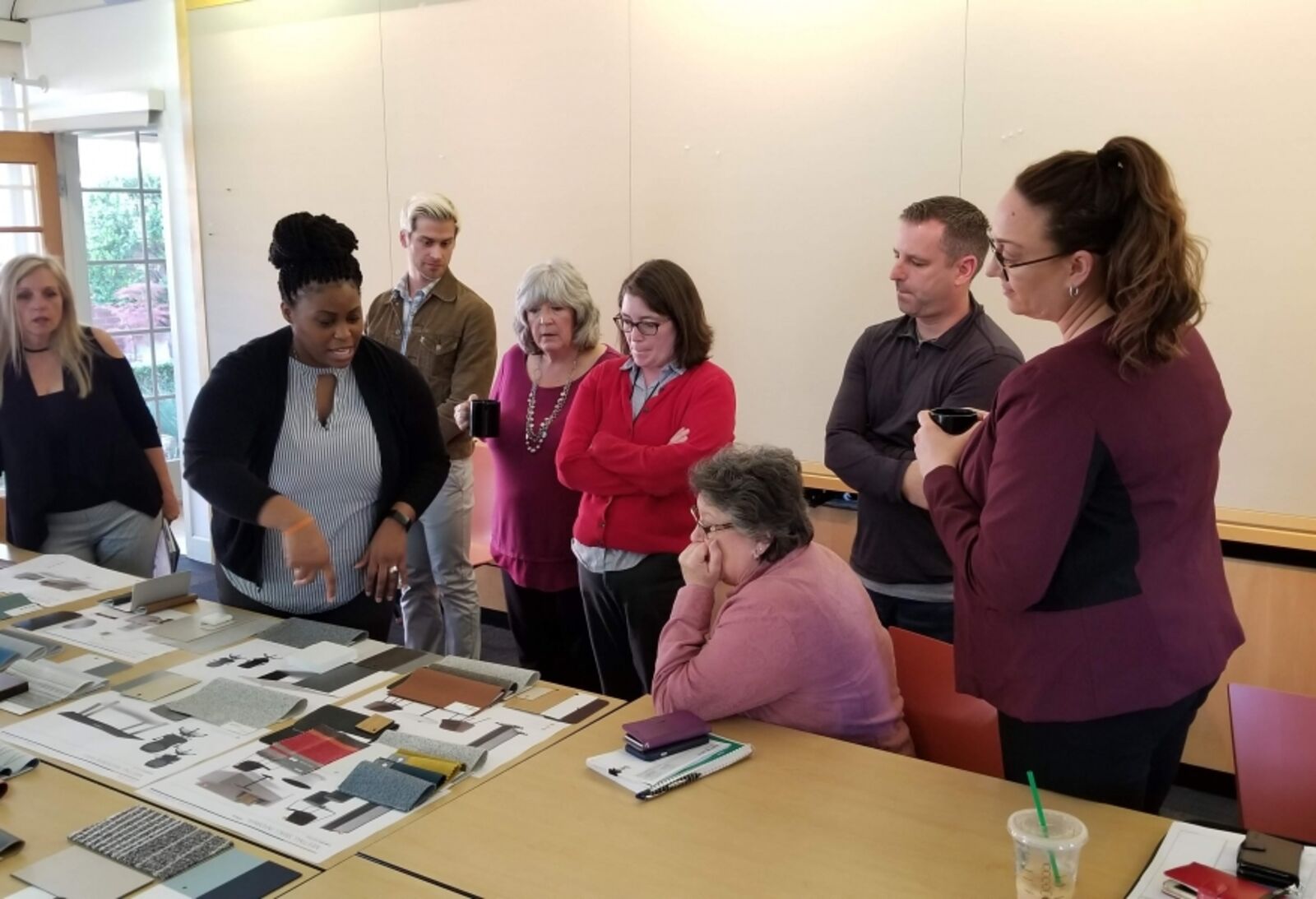
Humans of ZGF: Camilla Watson
ZGF interior designer and associate principal Camilla Watson, IIDA, has helped shape interior environments for some of the firm’s top corporate, healthcare and public-sector clients. A Chicago native, Camilla uses music, art, travel, and Post-its to power her creative process. She has worked extensively with Microsoft, the California Department of General Services, AMLI Residential and more to create healthy spaces that respond to the human experience.
In our latest Humans of ZGF Q&A and video feature, we go behind the scenes with Camilla to learn about what inspires her at work.
You’ve mentioned before that teamwork informs your creative process. How so? For me, it’s all about the team. No one does anything alone. It’s the collaboration, it’s the inspiration, it’s taking your idea and blending it with someone else’s idea to make it an even better idea. That’s the fun process. It’s hard when you get tunnel vision and you think you’re on the right track, but it’s not until you’re able to collaborate with someone else – perhaps another designer, a client, or a random person who has no idea why you just got excited mid-conversation – but they said something that really related to your project.
What do you do when you encounter a complicated creative challenge? There are definitely challenges in the creative process, even when you’re trying to keep it fun and collaborative. You just hit a wall. Sometimes you get overwhelmed to the point where it stops you in your tracks and you’re not able to move forward. But with schedules and deadlines, you have to continue moving forward. Music, art, all different types of inspiration, can allow you to take a moment, capture your thoughts, and then keep going.
How does music help you? I turn to music to generate ideas or get into my creative headspace. I am definitely not a morning person, so that 8 a.m. to 5 p.m. cycle can make it hard to be creative. A lot of my creativity comes in the evening. During the day, using different types of music for different tasks helps get the inspiration flowing. If I really need to focus, I tend to pick something upbeat. There’s always time for Beyoncé in every design process. I pull a lot of musical inspiration from Erykah Badu, Janelle Monae, and Miguel. I listen to a lot of hip hop. The Roots are really inspirational. Sometimes I like to listen to the score of movies I’ve seen. Even though it tends to be classical, it’s relaxing and takes me back to a particular scene.
What about imagery as inspiration? From a design standpoint, it’s important to not just look at other spaces to see what’s been done. We’re always looking for new and innovative solutions to design problems. I like to look at images that create a mood. I look for art made during a specific time period. If I’m working on a project in a specific area, I like to look at the local artists in that area—specifically street art, which I think ties into my Chicago upbringing.
Tell us more about your Chicago roots. How has that influenced your work? Chicago is a big inspiration for me. Not just the architecture—because Chicago is a very architecturally-significant city in the country and the world—but also the street art and gritty nature. I like to think that my design draws from this inspiration growing up on the South Side. A lot of the purity, but also the layering and the grit—or at least the things I hope are in my design.
Have you done much traveling? I’ve definitely gotten bit by the travel bug recently. I went with a group of friends to Egypt in 2018 and was so inspired by the architecture. It’s incredible the things they were able to build, with such mathematical precision and context of the environment around them.
We hear you have a habit of leaving Post-it notes around your table. Discuss. I like to leave Post-it notes as a mark of inspiration, both for myself and the people who visit my desk. Sometimes it’s good to catch a glimpse of a note that says, ‘Get it Together.’ It instantly changes your mood.
How do you conceptualize design before you embark on a new project? For me, design is about synthesizing a lot of information from different stakeholders to inform shape, scale and volume. It’s putting it into a space that evokes a feeling or a certain mood.
How do you define a successful space? Ultimately, the success of a project is based on how happy the people who inhabit the space are. Sometimes there are compromises. It’s not about what I think is the most beautiful solution. It is, ‘What do I think is the best solution for the end user? What would make them the happiest?’
Camilla Watson, IIDA, is an interior designer and associate principal in ZGF’s Seattle office.