Big Room = Big Changes (Thanks, COVID-19)
By David Staczek
Co-location and collaboration spaces have been integral tools (and team philosophies) in bringing together teams on large-scale projects for the last decade. We’ve had to make some serious adjustments to the fundamental ideas of team space and what it means to break down silos during this pandemic, but what has it taught us about the Big Room? Have we figured out new amazing ways to keep the barriers down and still work in a highly collaborative, creative environment—even if virtually? The answer is yes—and don’t take our word for it, ask our clients. Have we, as the project team and as individuals, benefited from this grand experiment in digital collaboration? Yes, we have. Here’s how.
For one healthcare master plan project in the Pacific Northwest, the project kicked off in January and we had established a Big Room within ZGF’s office. When COVID-19 hit, we quickly shifted to a “virtual Big Room,” using a range of formats for virtual meetings and collaboration tools such as Microsoft Teams, Microsoft Whiteboard, Microsoft Mural, Bluebeam, GoToMeetings, and more. Some institutions can only use certain types of software, so it has been important to find a format that accommodates everyone.
We still have the contractor, consultants, trade partners and all other teammates we typically have in the Big Room—just virtually. Anyone can take control, share their screen, draw on the screen, weigh in on an issue, or share a new idea as if we are in the same room. Even team members who would normally be timid to pick up a pencil and draw in a room full of architects have opened up to this new way of collaborating. It’s almost as if the virtual barrier (or lack thereof) has leveled the playing field even more.
The client’s project manager supports the virtual Big Room concept and acknowledges the amount of work the team has been able to do remotely. He believes its success is still rooted in choosing the right people, with the right skillsets, experience, and personalities that can work well together, plus a well-defined plan and an open environment to be able to ask the right questions.
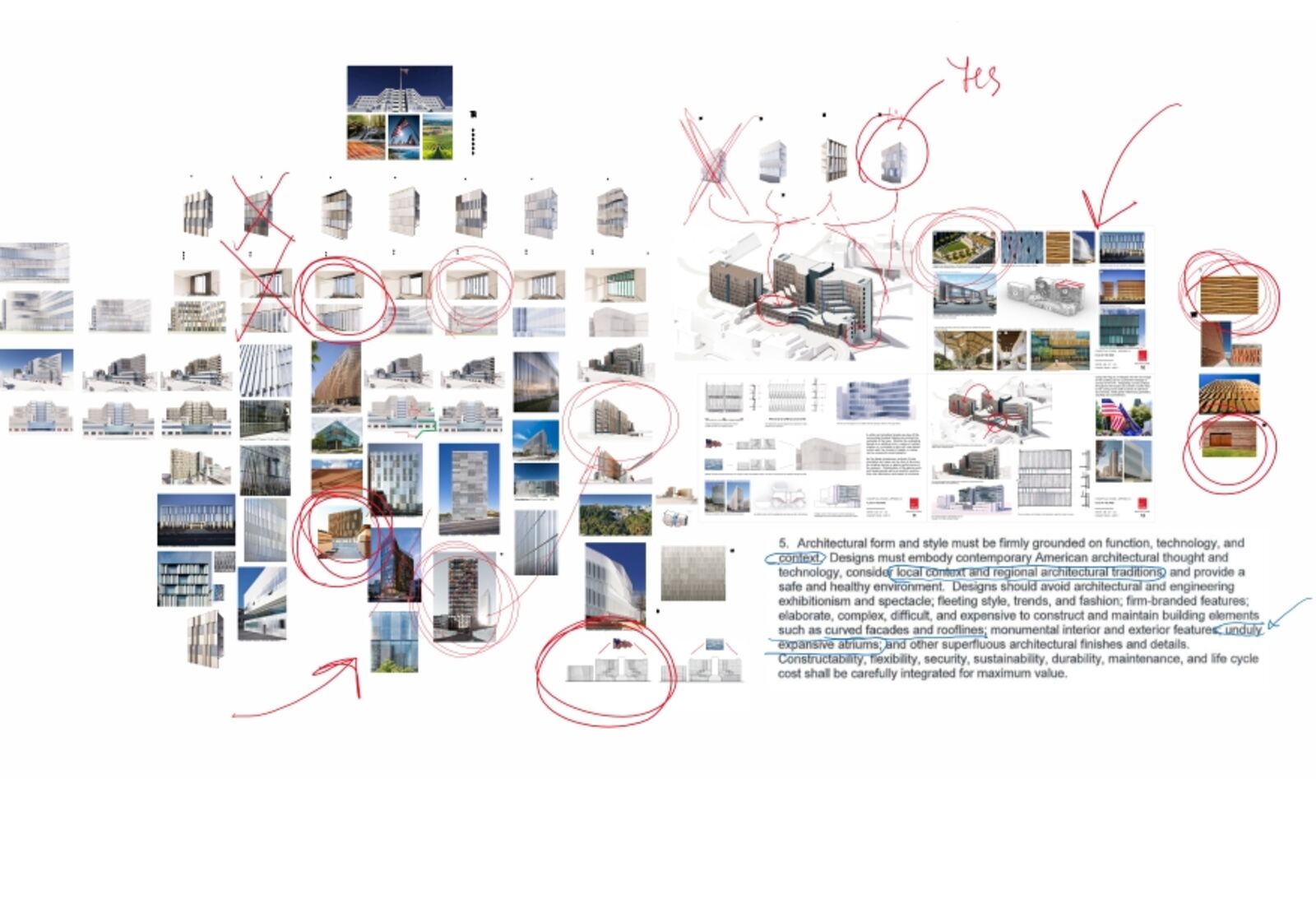
For another project based in our Los Angeles office—a new 1,250,000 SF workplace campus for 5,000 State of California employees—our plans for an onsite Big Room changed fast, making virtual meetings the new normal. Initially the client was skeptical that virtual meetings could keep the project on track; but utilizing Bluebeam for live annotating and the Revit plug-in Enscape for 3D visualization, the project team has maintained its rigorous schedule despite the pandemic.
“The ZGF team has done a great job leveraging technology as well as managing the virtual process to keep the design presentations and coordination progressing at warp speed,” said Sean Carolan, operations manager at Hensel Phelps.
We also experimented with a new format for the exterior material palette review process. The design team created a shippable kit for façade materials—almost like a meal kit or clothing subscription box—complete with instructions for set-up and virtual connectivity outdoors so the client could review options in natural light.
Pre-pandemic, we spent a lot of time in transit—often going to project sites for weeks at a time to facilitate user workshops, client meetings and design coordination meetings. Less travel (well, no travel really) in the time of COVID-19 has not only reduced our carbon footprint, it has resulted in newfound productivity and efficiency.
We’re in the middle of a 200,000 SF medical campus expansion project in Chicago, for example. Early in the design process, ZGF team members would travel from Portland to Chicago once a week for a full day of meetings. Factoring in the travel time on either end, we would lose a day or two of valuable time during the work week. This stopped entirely when COVID-19 happened and now we have virtual Big Room meetings on a regular basis.
Many of us are finding that we are more productive and focused at home, with all that time back that was previously spent in transit. Plus, we can do two things at once—listening in on meetings while simultaneously advancing the design and the drawings. Now that every meeting is virtual, they are carefully planned and set up to be viewed that way. Gone are the days of trying to find a last-minute conference room (at least for now).
Virtual Meetings = Anyone Can Join = More Inclusive
Another very interesting improvement to the virtual Big Room has been who can attend and how often. Now, any meeting can really be attended by anyone—there is no limit. Junior architects and designers can listen and participate in every design presentation. Mechanical trade partners have even listened in and watched us draw on the screen.
This open attendance policy has saved time for our clients (and their projects) now that we don’t have to re-enact the design meetings (or any meeting for that matter) to catch the rest of the team up to speed. Too often, junior designers work on a project element for weeks or months and then don’t get to see the client’s reaction or feedback in real time. There’s something to be said about the instantaneous connection between production, presentation, reaction and direction. The whole team can see their designs presented to the client, learn the art of storytelling, and witness the give-and-take that happens in these meetings.
While COVID-19 may have upended our established version of the Big Room, it has also paved the way for a new-and-improved model of collaboration. Most importantly, it has proven that we do not always need to physically be in the Big Room together (although it is nice to see people face to face) to deliver the best possible projects.