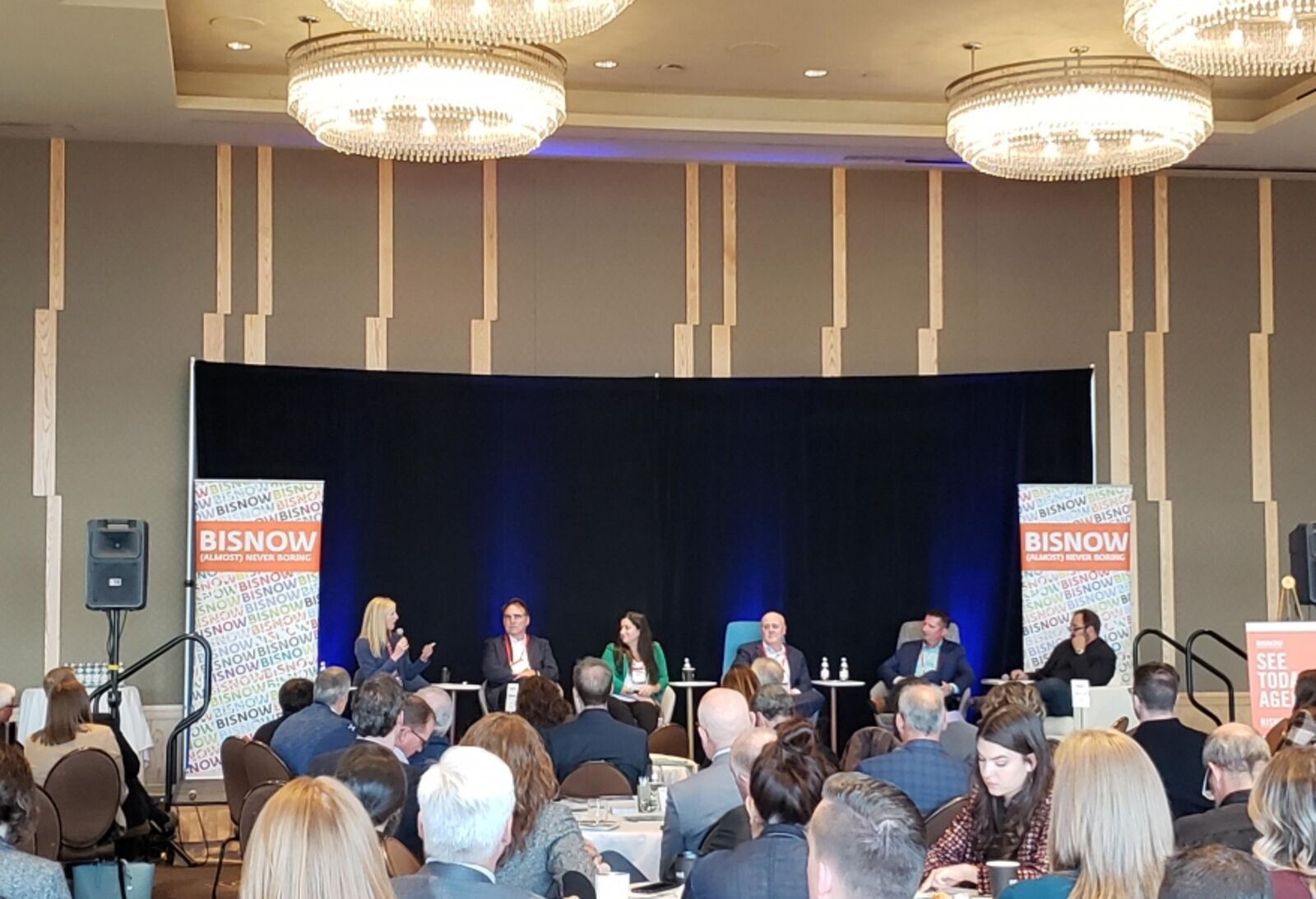
Recap: Bisnow’s National Healthcare Series event in Seattle
Last week at Bisnow’s National Healthcare Series event in Seattle, ZGF partner Victoria Nichols (on the left in the above photo) took to the stage with fellow panelists J. Michael Marsh (President & CEO, Overlake Medical Center), Daniella Moreano Wahler (Senior Associate, PAE Consulting Engineers), Kyle Raschkow (Project Executive, Abbott Construction), Von Lambert (Senior Project Manager, Rider Levett Bucknall) and moderator Austen Angell (CEO, Modern Edge) for a discussion about trends shaping the future of healthcare facility design and construction. Here are Victoria’s top takeaways on the state of the industry, as heard during the event:
The impact of workforce constraints and shifting worker demographics on healthcare design: It’s in many of the conversations we have with clients. What can we do to attract and retain talent through this project? How can we make this a place everyone wants to come? We’re starting to borrow from what we see in workplace design and infuse that into healthcare.
Adopting a consumer mindset: Because our extensive work with children’s hospitals locally and nationally, what we’ve been doing for a long time is making its way out into the broader healthcare world. That means adopting a consumer mindset for the healthcare experience: addressing wayfinding, moving care closer to where the customers are, and meeting the needs of not just patients, but their families.
The trend toward human-centered design: Healthcare settings can be overwhelming for patients of any age, and their families. We believe that light-infused, nature-inspired spaces can help patients and families feel at ease, no matter how serious or momentous the reason for their visit, and no matter the length of their stays.
Providing landscaped healing gardens – which offer places of respite for calm and contemplation – can improve patient outcomes. One doesn’t need to be outside to enjoy these landscapes, either. Their visual cues are legible from the indoors and keep us connected to the natural world.
Research has shown that the right quality and quantity of light at the right time regulates human circadian rhythms, which are vital to everything from sleep, to mental health, to cognition, to disease prevention. That has wide-ranging implications for the interior environments we design. We’ve now incorporated circadian lighting – or color-tunable LED lighting – into a variety of indoor settings to complement natural daylight.
Sometimes it’s the little things that mean the most to patients and families: During a stressful stay, including enough hangers in a patient-room closet, making it easier to move in and out of a hospital wing, and offering quiet and light-filled spaces for respite, can make the biggest impact. These are some of the insights that we glean by listening to stakeholders – who sometimes number in the hundreds – during the design of a major project.
The perceived value of resiliency design: Beyond designing resilient projects, there’s an untapped need for resiliency planning. After an event happens, users don’t often know what normal damage looks like or when it’s time to evacuate. There’s a lot of money being invested in infrastructure planning, but less so on training and operational planning.
On innovate ways to cut costs and drive efficiency: A ZGF project in Cincinnati is benefitting from the use of offsite pipe-rack prefabrication. There are enormous schedule benefits from building these racks – enough of them to serve entire patient wings – offsite. As a result, the project has also benefited from superior quality control and safety. The integrated design process allows us to design the facility in tandem with the care processes that will take place within the future building, thus optimizing space, increasing efficiency in operations, and enhancing the patient and staff experience. All these things contribute to a greater ROI.