

At the Intersection of Community and Competition
University of Virginia, The Athletics Village
Sports and Human Performance
With the goal to redefine how student-athletes achieve academic excellence, compete for championships, and become future leaders, the University of Virginia (UVA) embarked on a journey to create a new athletic training ground that connects 750 student-athletes across 27 varsity sports. This multi-phased project includes the Hardie Football Operations Center (FOC), the Harrison Olympic Sports Center (OSC), and new practice fields.
Location
Charlottesville, Virginia
Square Feet
93,000 (FOC); 141,000 (OSC)
Completion date
2024 (FOC); 2025 (OSC)
Project Component
Programming
Architecture Services
Interior design

The new athletic village is a central hub where all men’s and women’s Division I programs can come together, connect, and build community.
The Development of the Athletic Village
In 2015, UVA introduced a comprehensive master plan for North Grounds, fundamentally reimagining how athletes, staff, and the broader community engage with the campus. The plan prioritized improved circulation to nearby arenas and fields, increased interaction between players and staff, and the creation of a central hub to unite all sports programs. Following the demolition of University Hall—the university’s original training facility—athletic programs were temporarily relocated to modular trailers. During this transitional phase, ZGF Architects partnered with the university to guide the design and implementation of future phased developments.
The following phase moved the football players out of the McCue Center, which previously served as UVA football's headquarters for over 30 years. Although the McCue Center was one of the finest facilities in its conference at the time of its opening, the building was no longer up to the standards of today’s Power Four conferences. Relocating to a new 93,000-square-foot Hardie Football Operations Center created a critical opportunity to renovate and expand the existing McCue Center for additional men’s and women’s Division I varsity sports. The transformed center now serves as the 141,000-square-foot Harrison Olympic Sports Center, providing upgraded training environments, enhanced recovery and sports medicine areas, and improved support spaces for coaches and staff.

Situated on a World Heritage site and along a major pedestrian corridor, the new athletics complex brings together sports and community life. At its center, a pedestrian promenade acts as a western gateway to the historic North Grounds campus and a connective spine to the John Paul Jones Arena, doubling as a dynamic gathering space on game days. Two new natural grass practice fields connect directly to the facilities, with additional fields and parking planned for future phases.
To expedite the relocation of student-athletes from temporary trailers, ZGF streamlined and accelerated the construction process. By engaging the same contractor for both facilities, the team was able to simplify mobilization and coordinate excavation and construction activities simultaneously. Maintaining a consistent group of subcontractors across both projects further enhanced efficiency, enabling bulk material purchasing and ensuring uniform quality. Additionally, the use of shared products across both buildings helped streamline procurement and reduce potential delays.

The Hardie Football Operations Center (left) and Harrison Olympic Sports Center (right) share a cohesive material palette, creating a unified architectural expression across the campus.
Every Second Counts
The athletic village is conceived as a holistic, home-away-from-home for student-athletes—supporting mind, body, and spirit within a unified environment. With NCAA limits allowing only 20 hours of supervised practice time each week, every moment outside of training becomes equally valuable. In response, each facility is designed for maximum efficiency, carefully organizing spaces to minimize travel time and minimize unnecessary movement between functions. This intentional planning not only streamlines daily routines but also creates more opportunities for rest, recovery, academic focus, and mental well-being.
The Hardie Football Operations Center provides 93,000 square-feet of full spectrum services for athletes, coaches, and staff, including a strength and conditioning center, locker rooms, a sports medicine suite, a dedicated dining hall, a players lounge, position meeting rooms, and support spaces.

The Harrison Olympic Sports Center, comprised of the 78,000 square-foot existing McCue Training Facility and 63,000 square-foot addition, supports men’s and women’s lacrosse, soccer, track and field, rowing, and field hockey. The facility consolidates training and performance areas and includes locker rooms, a sports medicine suite, hydrotherapy suite, offices, multipurpose meeting rooms, and support spaces.

A dedicated dining hall in FOC allows the team and staff to eat all their performance-enhancing meals on-site for minimal interruption between practices. In each facility, communal study lounges offer space for students to work between practice or treatment instead of trekking back to the library or dorms. Player locker rooms feature adaptable integrated furniture lockers that can be opened to store gear and apparel or closed to provide quick seating for impromptu team huddles. The sports medicine suites provide comprehensive treatments, from bone density testing to hydrotherapy, ensuring players can receive holistic healthcare in one convenient location.
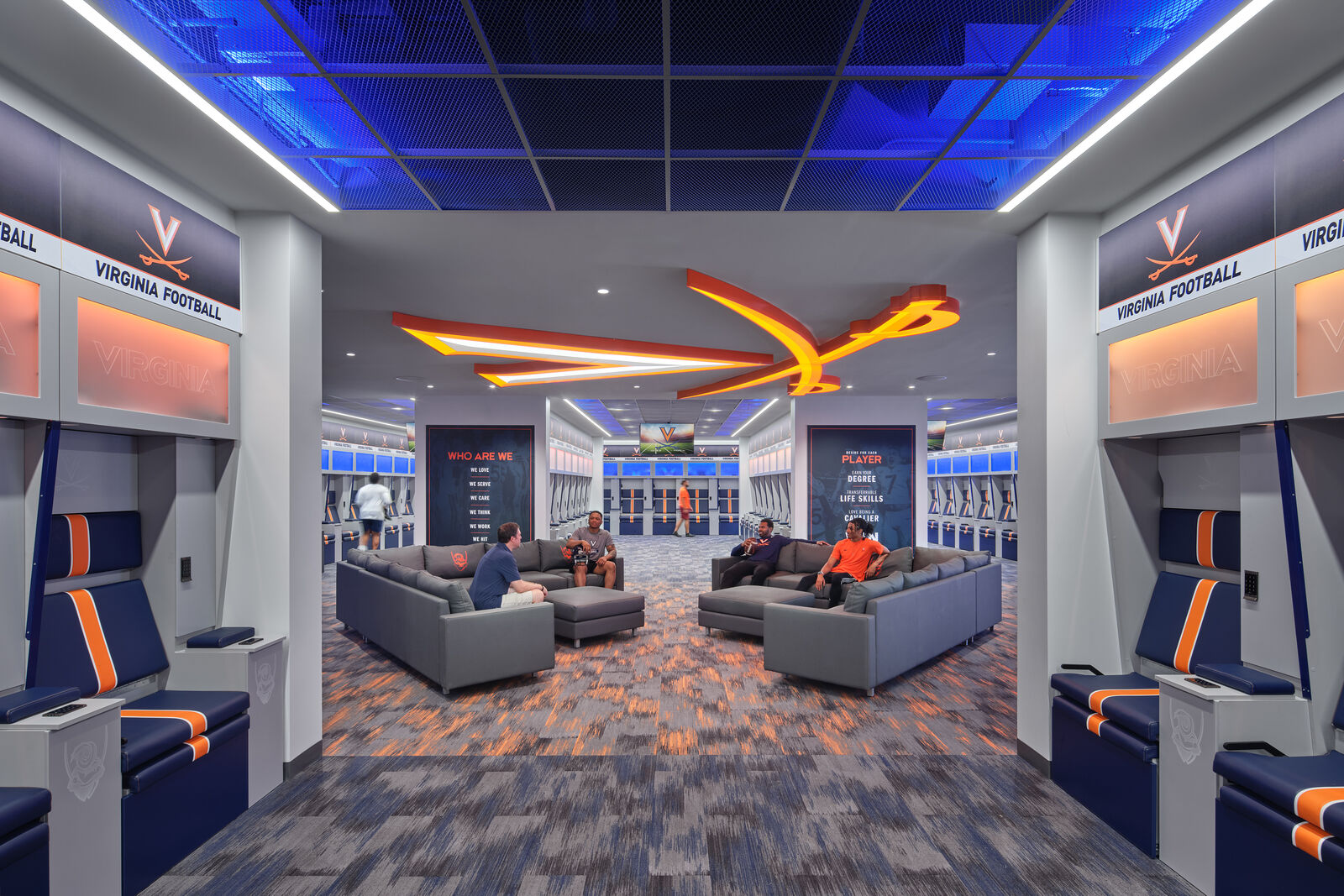
Expansive player locker rooms provide ample seating for pre-game huddles and post-game debriefs.

The sports medicine suites provide space for staff to work both openly in the treatment area or privately in exam rooms.

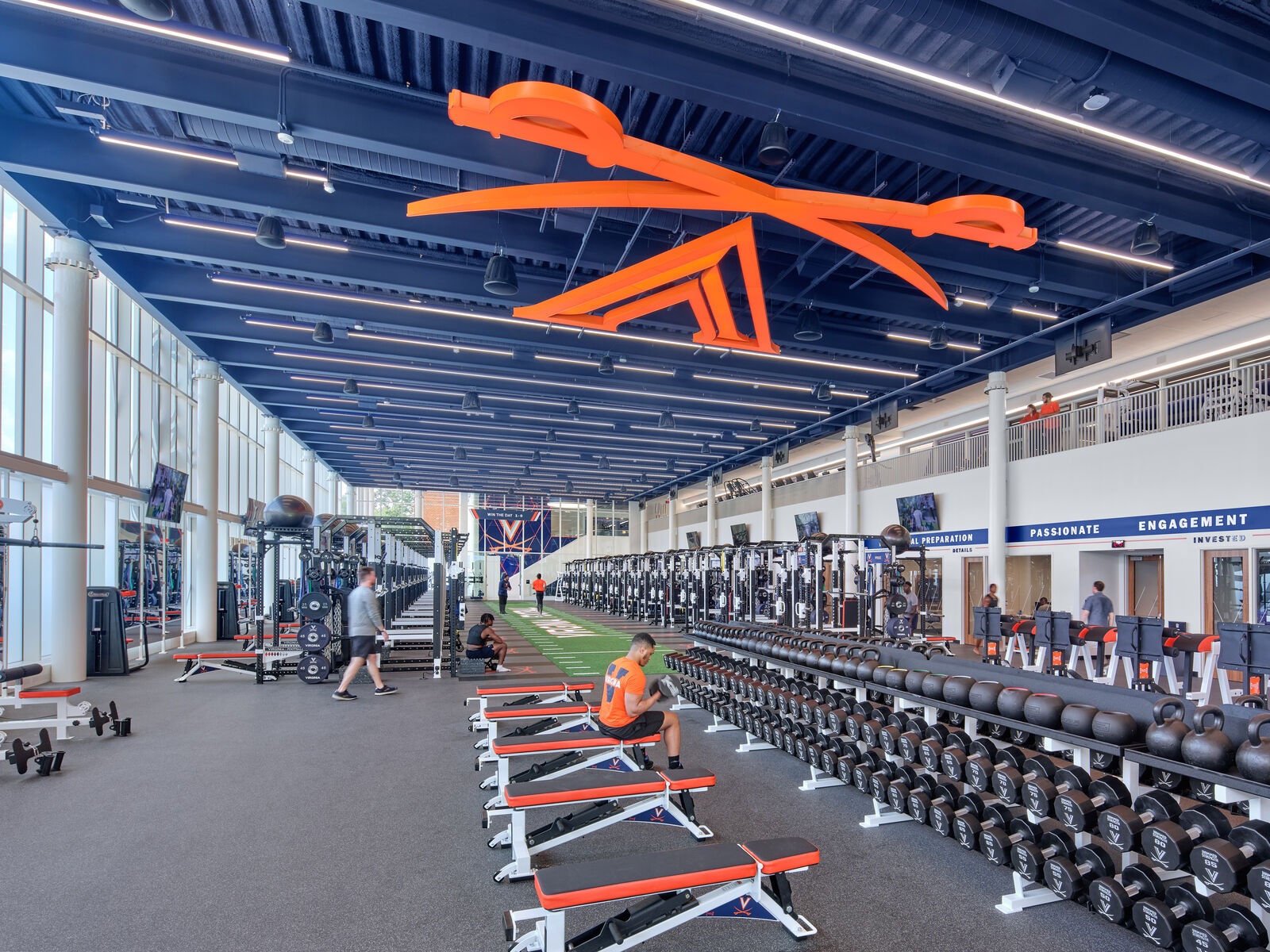
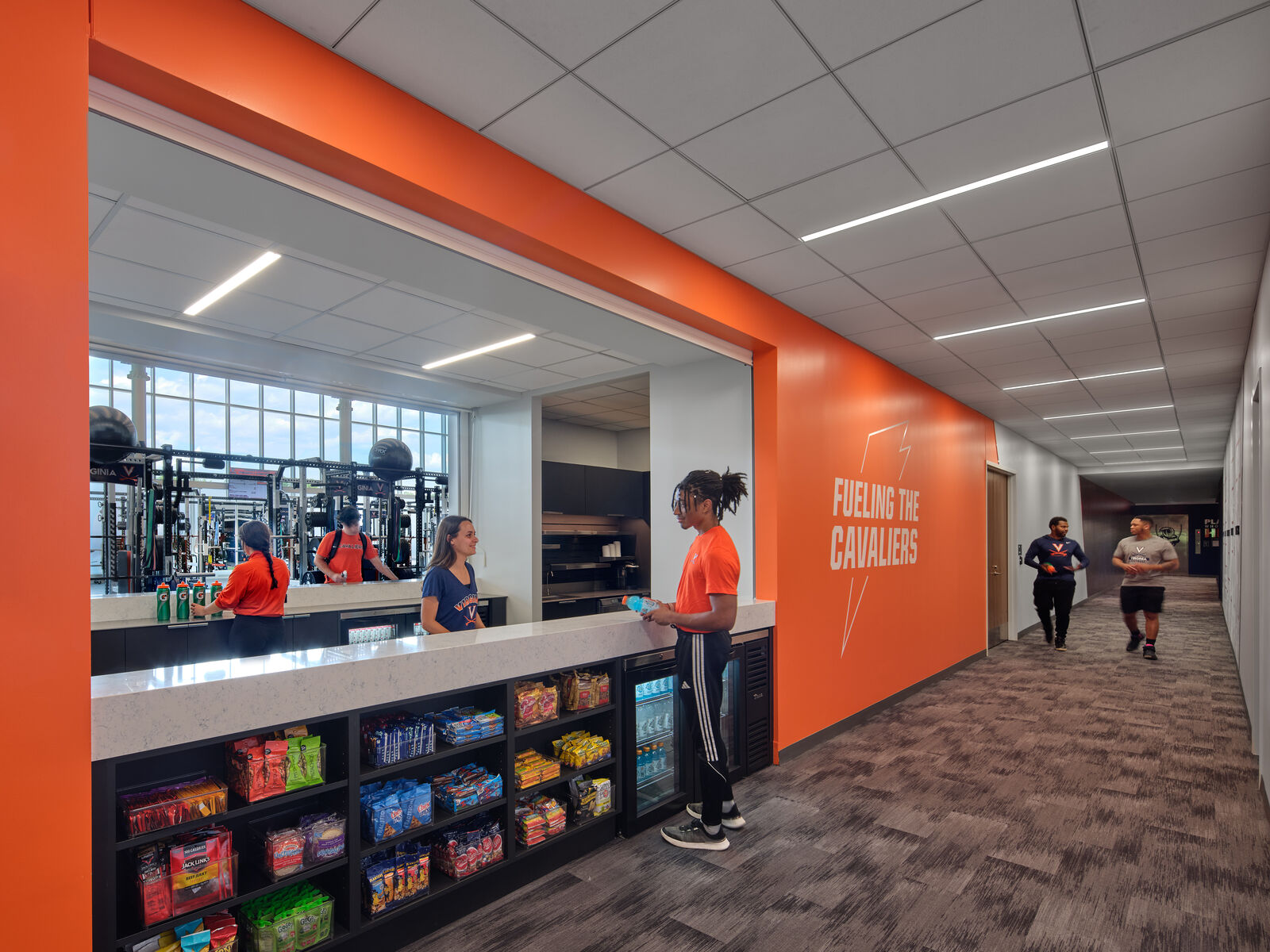
In the FOC, a 14,000 square-foot strength and conditioning center connects directly to the new practice field, providing seamless transitions between field drills and the weight room. Within the strength and conditioning center, a fuel bar staffed by nutritionists provides pre-practice and post-practice snacks and supplements tailored to each individual athlete’s health needs.

The FOC strength and conditioning center features high-vaulted ceilings, expansive windows, and a cardio mezzanine.
"The new facility is going to provide us what we need to compete as a team. We also have the space to truly help our student-athletes grow personally and professionally."
Tony Elliott, Head Football Coach
Looking Back, Sprinting Forward
In July of 2021, the NCAA implemented a new Name, Image, and Likeness (NIL) policy, permitting student-athletes to earn money from various endorsement deals for the first time in collegiate history. In May of 2024, the NCAA reached a groundbreaking agreement to allow athletes in the Power Four conferences to be paid directly by the universities they play for. These new policies are changing the future landscape of college sports by bringing an end to the century-old tradition of amateurism. With NIL deals and endorsements on the table, recruiting top talent has become more competitive than ever. UVA’s new facilities confront this challenge by focusing beyond financial incentives to curate a holistic athletic experience that distinguishes itself among the recruiting landscape.
Beyond the development of great athletes, UVA’s athletics program strives to nurture great character. The new facilities create an environment that promotes camaraderie, honors legacy, and builds leadership. Player lounges and dining halls offer family-like environments by encouraging athletes and staff to connect and interact outside of training. Expansive double-height lobbies and floor-to-ceiling windows flood the interiors with natural daylight, reinforcing a sense of openness, well-being, and connection throughout the spaces.

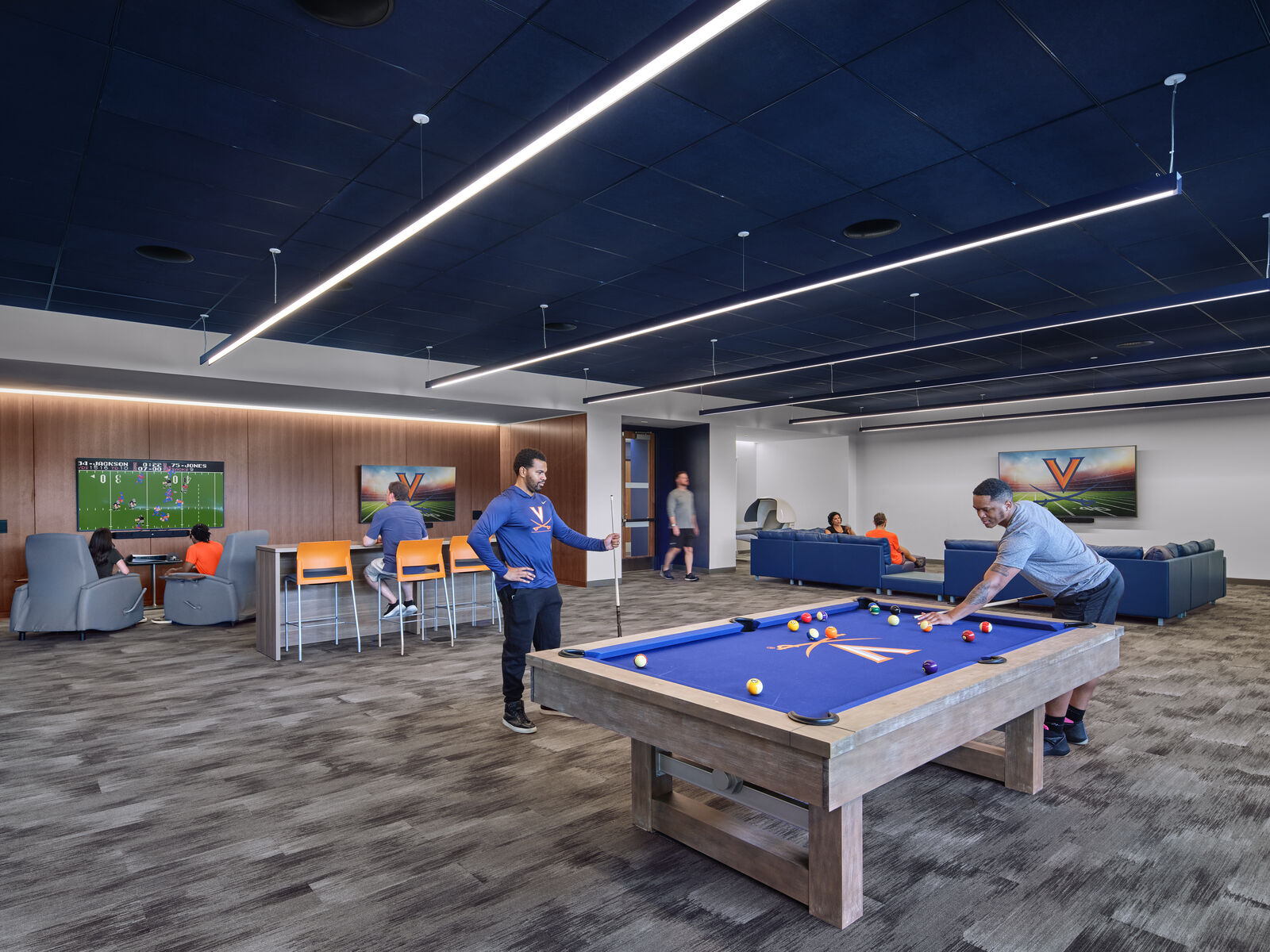
Player lounges include a variety of amenities, from pool tables to video games, for athletes to unwind and relax in their free time.
ZGF collaborated with Forty Nine Degrees to seamlessly integrate environmental graphics in each building that showcase the history and mission of each program. Throughout the facilities, branded moments spotlighting season schedules and program goals remind players and coaches of what they’re striving towards. At every turn, impactful character-building messages reinforce the essential qualities needed for success on and off the fields. An alumni corridor in FOC showcases the program’s achievements, offering players and recruits a glimpse of their potential future and the opportunities playing for UVA can provide. A memorial gear display is centrally located for both visiting recruits and players to pay tribute.


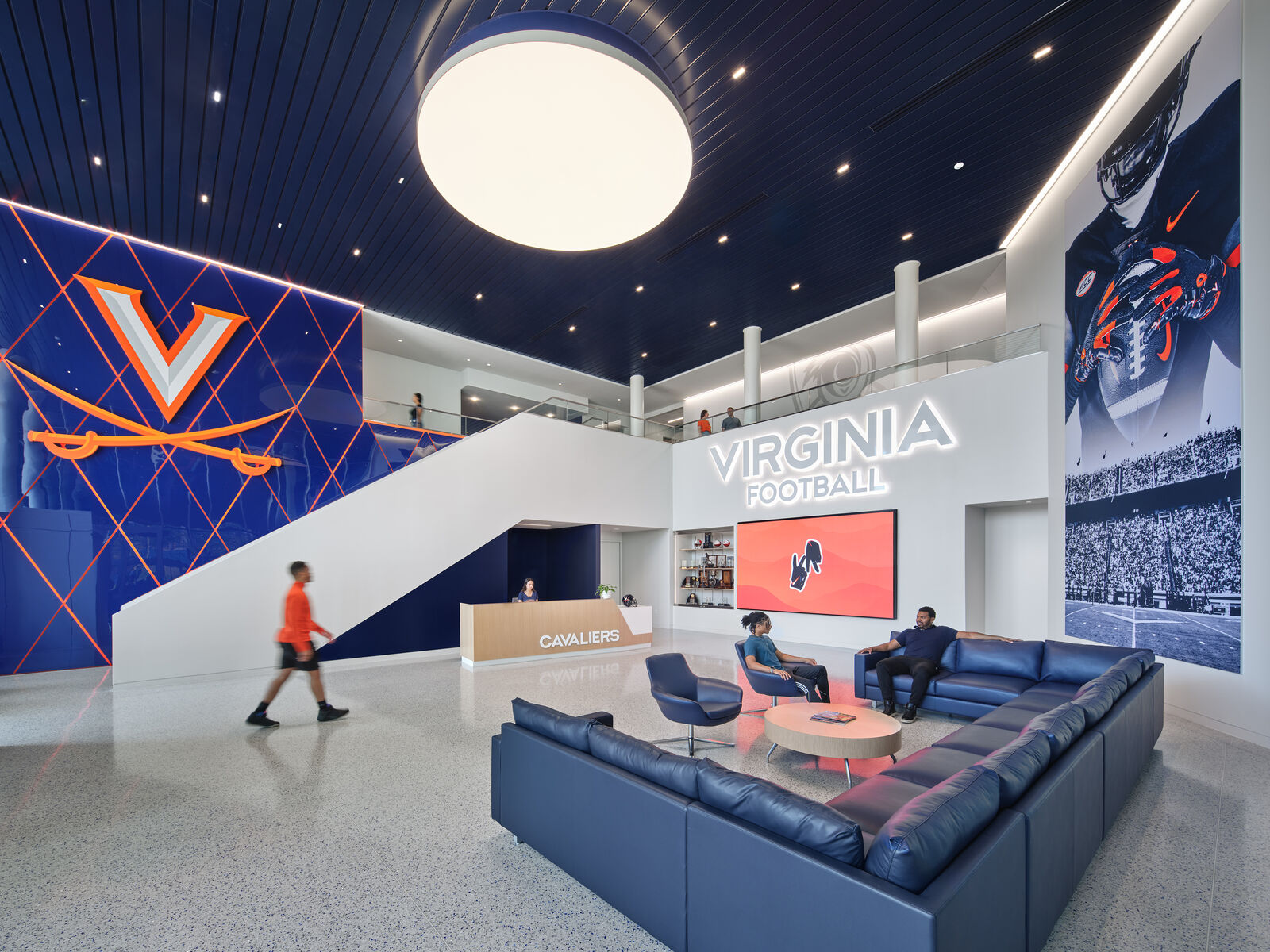
With more space, state-of-the-art equipment, and comprehensive amenities, the Hardie Football Operations Center and the Harrison Olympic Sports Center provide athletes and coaches with the resources they need to compete at the highest collegiate level. The Athletic Training Grounds is an environment where student-athletes can access industry-leading programming in academic achievement, career development, leadership development, and community engagement as an integral part of their UVA experience.

San Antonio Spurs, Victory Capital Performance Center

University of California, Los Angeles, Wasserman Football Center

University of Oregon, Hatfield-Dowlin Complex, Football Operations Center

BECU Storm, Center for Basketball Performance